
Some names arrive quietly and then suddenly show up everywhere. “Nitazene” is one of them. A few years ago it was a word mostly seen in chemistry journals. Today it appears in public health alerts, news coverage, and government drug reports.
In September 2025, the Drug Enforcement Administration (DEA) published a report describing nitazenes as an emerging threat. The agency wrote that nitazenes are “synthetic opioids similar to fentanyl but can match or surpass the potency of fentanyl.” The DEA also noted that people “will not realize they are buying nitazenes until it is too late,” because the drugs cannot be identified without lab testing.
That warning matters well beyond law enforcement. For families now seeking a luxury rehab or any kind of treatment for a loved one who uses opioids, knowing what may be in the drug supply is part of the conversation. This guide explains where the name comes from, what the research says about these drugs, and why they are so difficult to detect.
Where the Name “Nitazene” Comes From
Like many drug names, “nitazene” is a shorthand built from chemistry. According to the DEA’s Diversion Control Division, the drugs belong to a group called benzimidazole-opioids, “also known as 2-benzyl benzimidazole opioids or nitazenes.” The chemical name describes the core structure of the molecule, a benzimidazole ring with a benzyl group attached.
The word “nitazene” itself traces back to one specific compound. A December 2024 naming guide from the Center for Forensic Science Research and Education (CFSRE) states that “Nitazene analogue nomenclature stems from the prototypical drug Etonitazene.” In other words, etonitazene became the root word, and newer versions were named by changing the front or middle of it.
How the Family Names Work
The CFSRE guide explains that changes to one part of the molecule are shown by adding a prefix before the root “nitazene.” That is how names such as metonitazene, isotonitazene, and clonitazene were formed. When a version lacks a particular chemical piece known as the nitro group, the guide says the name includes “des” before the root, which gives names like etodesnitazene.
So while the names can look intimidating, they follow a pattern. If a word ends in “nitazene,” it signals a relative of etonitazene.
A 1950s Discovery That Was Never Approved
Nitazenes are not new inventions. The DEA reports that “in the late 1950s, the pharmaceutical research laboratories of the Swiss chemical company CIBA Aktiengesellschaft synthesized numerous substances in this structural class.” They were studied as possible pain relievers.
They never became medicines. A 2023 review by Pergolizzi and colleagues describes nitazenes as synthetic opioids first developed in the 1950s that were never approved for market. The DEA states that benzimidazole-opioids “are not approved for medical use in the United States.”
For decades, they stayed mostly in the scientific literature. According to the DEA, its national forensic lab reporting system recorded few reports of these drugs until 2019. Since then, it has received more than 8,000 reports involving 23 benzimidazole-opioids.
How Strong Are Nitazenes?
Potency is the main reason nitazenes worry health officials. The DEA notes that “the potency of benzimidazole-opioids varies based on the specific compound,” so there is no single figure that applies to the whole family.
Some examples help put this into perspective. An alert from the Indian Health Service states that protonitazene is about 200 times more potent than morphine as a painkiller. The same alert cites the National Institute on Drug Abuse, which says fentanyl is 50 to 100 times more potent than morphine. The Pergolizzi review describes some nitazenes as roughly ten times stronger than fentanyl.
The DEA’s September 2025 report adds another concern: “When combined with fentanyl, the effects of both drugs are compounded, which significantly increases the chances of a fatal overdose.”
Why Nitazenes Are So Hard to Spot
The biggest problem with nitazenes is not only their strength. It is how easily they stay hidden. Several factors, each described by public health or law enforcement sources, make them difficult to recognize.
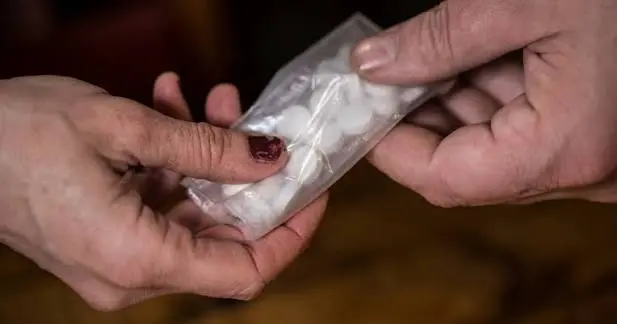
- Counterfeit pills: The DEA’s 2025 report shows counterfeit “Dilaudid M-8” pills found to contain isotonitazene, meaning nitazenes can look like an ordinary prescription tablet.
- Mixed into other drugs: The Pergolizzi review notes that nitazenes are often mixed with fentanyl or other substances, so a person may not know they are present.
- Missed by fentanyl test strips: Toward the Heart, a Canadian harm reduction resource, states plainly that “fentanyl test strips cannot detect nitazenes.”
- Constantly changing chemistry: The DEA reports that chemical suppliers, mainly in China, introduce new nitazenes when existing ones are scheduled or become riskier to produce.
- Testing gaps in health care: The Indian Health Service lists making sure laboratory technology in healthcare facilities can screen for these emerging synthetic drugs as one of the challenges they create.
Taken together, these points explain why a nitazene can pass through several checkpoints without being noticed. A pill can look legitimate, a powder can contain more than one drug, and a common test may come back negative.
What Testing and Regulation Look Like Now
There has been some progress. A 2024 study by De Vrieze and colleagues in the Harm Reduction Journal evaluated nitazene immunoassay test strips and found that 24 of the 33 nitazene analogs tested cross-reacted with the strips. The researchers concluded that the strips “show potential to recognize the presence of nitazene analogues,” though not every version was detected.
On the legal side, the DEA states that 21 benzimidazole-opioids are currently controlled in Schedule I of the Controlled Substances Act, the most restrictive category. Internationally, a 2025 paper by Verbeek and Brinkman in Basic and Clinical Pharmacology and Toxicology reports that, as of 2024, the United Nations Office on Drugs and Crime listed seven nitazenes as Schedule I substances. The same paper notes that the European Union Drugs Agency is monitoring 81 new opioids, 16 of which are nitazenes.
It is also worth keeping scale in mind. The DEA’s 2025 report says “the current magnitude of the threat is relatively small compared to that of fentanyl,” and that DEA labs analyzed 1,048 drug exhibits containing a nitazene between January 2020 and the report’s release.
Naloxone Still Matters
Naloxone, the medication used to reverse opioid overdoses, is still a key tool. Toward the Heart states that “naloxone should work on overdoses caused by nitazenes.” However, more may be needed.
A 2023 study in JAMA Network Open, led by Dr. Alexandra Amaducci, found that emergency patients whose overdoses involved nitazenes needed more naloxone doses to be revived than patients whose overdoses involved fentanyl. The Indian Health Service alert similarly notes that naloxone is effective but may require higher doses with nitazenes.
The CDC advises people not to hesitate to call 911 during a suspected overdose and to stay with the person until help arrives or for at least four hours. Toward the Heart also notes that an overdose can come back after naloxone wears off.
Frequently Asked Questions (FAQs)
1. Is “nitazene” the name of one drug or many?
It is the name of a family. According to the CFSRE naming guide, the group takes its name from etonitazene, and related compounds such as isotonitazene, metonitazene, and protonitazene are named by adding prefixes to that root.
2. Were nitazenes ever used as prescription medicines?
No. The DEA reports they were first made in the late 1950s by the Swiss company CIBA during research on pain relievers, but they are not approved for medical use in the United States.
3. Can a regular fentanyl test strip show whether nitazenes are present?
No. Toward the Heart states that fentanyl test strips cannot detect nitazenes. Separate nitazene test strips exist, and a 2024 Harm Reduction Journal study found they reacted to many, though not all, of the nitazene versions tested.
Also READ
- WTE Meaning in Text: What It Really Means in Chats, Social Media & Online (2026 Guide)
- TS Meaning in Text from a Boy: What It Really Means in Messages (2026 Guide)
- THX Meaning in Text: What It Really Means, When to Use It & Why It’s Still Popular in 2026